Roof Pitch Calculator
Find out how steep a roof is using two measurements: how far it rises and how far it travels horizontally. No roofing experience needed.
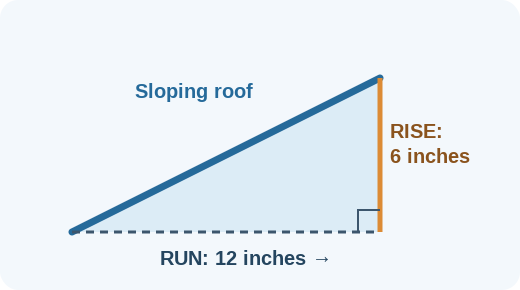
Not sure what “rise” or “run” means? See the labeled diagrams and beginner’s guide below ↓
Enter two measurements
Example: 6 inches up for every 12 inches across. These are example numbers, not measurements of your roof.
Illustrated beginner’s guide
What is roof pitch?
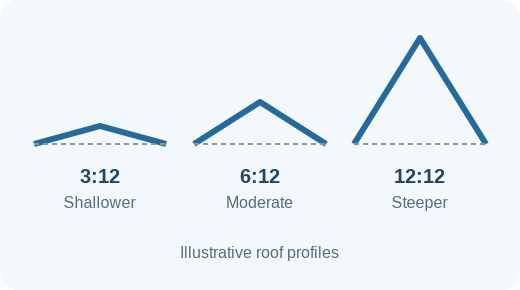
Roof pitch tells you how steep a roof is. In the United States it is commonly written as a ratio such as 6:12, spoken as “six in twelve.” That means the roof rises 6 inches for every 12 inches you move horizontally toward its high point.
What are rise and run?
Rise is the vertical change in height. Run is the horizontal distance beneath that change. The run is not the length measured along the sloped shingles. Both measurements must use the same unit, such as inches.
How do I use the calculator?
- Find the roof’s rise and horizontal run from reliable plans, an existing roof report, or a qualified roofing professional. Do not climb onto a roof to obtain them.
- Enter the rise in inches. For our example, enter 6.
- Enter the matching horizontal run in inches. For our example, enter 12.
- Click Calculate roof pitch. The result will be 6:12, approximately 26.6 degrees, with a roof-area multiplier of approximately 1.118.
How does the math work?
Divide the rise by the horizontal run, then multiply by 12. This converts any pair of measurements to the familiar “rise per 12 inches” format.
Roof pitch = (rise ÷ horizontal run) × 12 : 12
Example: (6 ÷ 12) × 12 = 6, so the roof pitch is 6:12.
The slope angle is calculated using the inverse tangent of rise divided by run. For 6:12, that is about 26.6°. The roof-area multiplier is the square root of 1 + (rise ÷ run) squared; for 6:12, it is approximately 1.118.
Why does roof pitch matter?
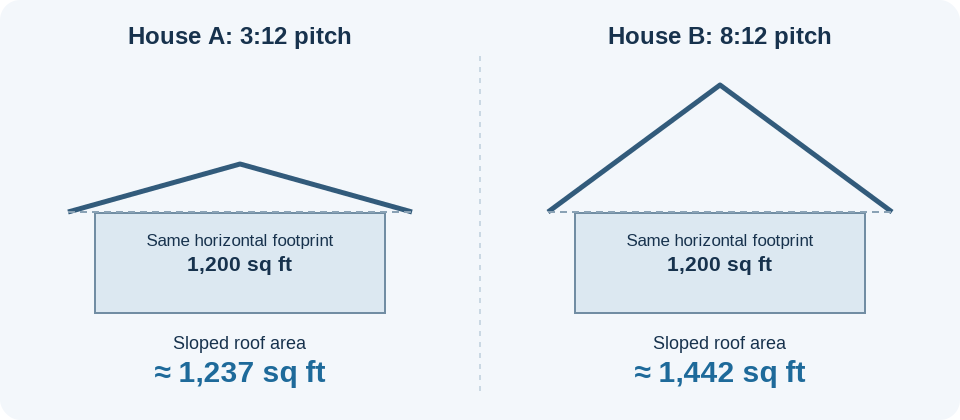
Why should you care about this number? Roof pitch changes how much surface there is to cover. Two houses can have the same footprint—the area you see looking straight down—but different amounts of sloping roof to cover.
Two houses, same footprint, different roof area
Imagine looking straight down at two simple houses. Each roof covers a rectangle that is 40 feet long and 30 feet wide, including the roof edges. That is 40 × 30 = 1,200 square feet of horizontal area for each house. The only difference in this example is the roof slope.
| Measurement | Gentle roof | Steeper roof |
|---|---|---|
| Horizontal footprint | 1,200 sq ft | 1,200 sq ft |
| Roof pitch | 3:12 | 8:12 |
| Area multiplier | 1.031 | 1.202 |
| Approximate sloped roof area | 1,237 sq ft | 1,442 sq ft |
The steeper roof has approximately 205 more square feet of surface than the gentler roof. This is one reason roof pitch matters when planning shingles or other roof coverings. These figures do not include extra material for cuts, fitting, or other installation needs.
What else does roof pitch affect?
- Materials: More sloping surface generally means more roofing material is needed.
- Installation planning: Steeper roofs can require different access methods, safety equipment, and labor.
- Product suitability: Some roofing products have minimum roof-slope requirements. Follow the manufacturer's instructions and local building codes.
- Understanding an estimate: A contractor may report more square feet of roof surface than the horizontal area of the house because the roof is sloped.
Important: This example assumes a simple roof with one consistent pitch and a 1,200-square-foot horizontal roof footprint. Real roofs may have overhangs, dormers, valleys, garages, or multiple slopes. Those features require additional measurements. A pitch calculator does not measure your entire roof.
Can I find roof pitch without climbing onto the roof?
Yes. You may be able to obtain it from construction drawings, an existing roof measurement report, or a roofing professional. Some ground-based measurements are possible with suitable tools, but they can be inaccurate if the viewing angle or reference points are wrong. Do not climb onto a roof or ladder just to use this calculator.
Common questions
Is 6:12 the same as 6 degrees?
No. 6:12 is a rise-to-run ratio. It corresponds to an angle of approximately 26.6 degrees, not 6 degrees.
What if my roof has more than one slope?
Calculate each roof section separately. One pitch cannot accurately describe a roof with different slopes.
Can I enter feet instead of inches?
The ratio works with any consistent unit, but these fields are labeled in inches. Convert both measurements to inches before entering them.
Does this calculator tell me how many shingles to buy?
No. It calculates slope information. For a simple roof, you can use the result with our Roof Shingle Calculator to estimate shingle quantities.
Important limitations
This is an educational geometry calculator, not a professional roof measurement, structural assessment, safety evaluation, or building-code determination. It assumes the rise and run refer to the same straight roof slope. Complex roof shapes require measurements for each section. Confirm dimensions and material requirements with a qualified professional before purchasing or building.