Roof Replacement Cost Calculator
Create an itemized, editable planning budget for replacing a simple roof. Every dollar amount below is an illustrative placeholder, not a live price quote.
Unfamiliar with roofing squares, flashing or tear-off? See the illustrated beginner's guide ↓
Enter your measurements and budget assumptions
Use your own supplier prices, local estimates or a contractor's written scope. The sample amounts are deliberately illustrative and are not researched market averages.
Illustrated beginner's guide
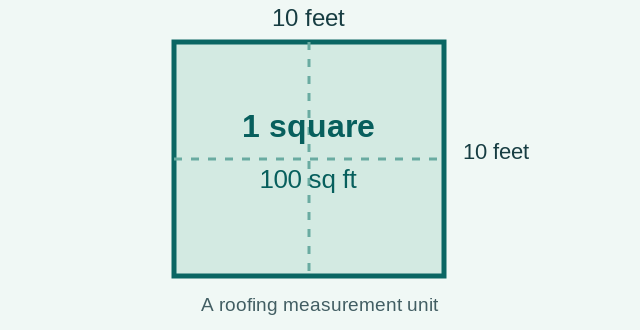
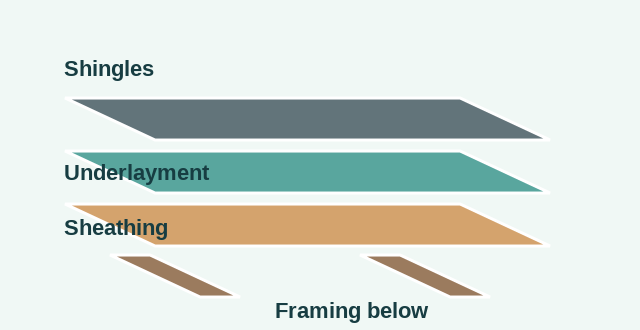
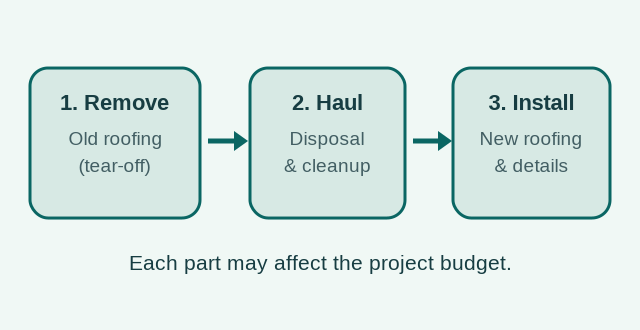
What does this calculator actually estimate?
It creates a preliminary budget by multiplying estimated roof area by the dollar amounts you enter and adding optional flat expenses. It helps you understand the parts of a roofing project, but cannot determine what a contractor should charge. Your actual roof may have multiple sections, dormers, valleys, steep or difficult access, extra layers to remove, or hidden conditions.
How do I get the measurements safely?
Use building plans, an existing roof measurement report, or measurements supplied by a qualified roofing professional. Length and width here mean the horizontal footprint of the roof, including overhangs. Do not climb onto a roof to measure it. A complex roof needs each section measured separately; entering one large rectangle can give misleading results.
What does each cost mean?
Shingle materials
Shingles are the outer roof covering. The tool calculates the sloped area, adds your selected shingle cutting allowance, and prices that material area by the square (100 square feet). Actual packaging and product coverage can require rounding up to whole bundles or other purchase units; this is not a shopping list.
Underlayment
Underlayment is a protective layer installed under the roofing material. The calculator uses sloped area without the shingle cutting allowance. Some projects also need separate ice-barrier products or specialty layers; include those costs in another field if applicable.
Installation labor
Labor is the work to install the new roof. This tool applies your labor rate to sloped roof squares. A contractor may price labor differently or bundle it with materials, safety measures, site protection, overhead and other costs. Avoid adding the same item twice.
Tear-off and disposal
Tear-off means removing existing roof materials. Disposal means collecting, transporting and disposing of removed materials. They are shown separately here for learning purposes, but a real proposal may combine them.
Flashing, permits and sheathing
Flashing helps keep water out around roof intersections and openings, such as chimneys or walls. Permits and inspections vary by jurisdiction. Sheathing is the roof deck under the underlayment. The amount needing replacement often cannot be determined from roof size alone; see our sheathing guide.
Contingency
A contingency is an optional personal budget cushion for uncertainty. It is not a required contractor charge and is not automatically part of a written quote. The calculator applies it to the estimated subtotal.
How the calculation works
- Horizontal area = roof length × roof width.
- Pitch multiplier = √(1 + (rise per 12 ÷ 12)²).
- Sloped area = horizontal area × pitch multiplier.
- Roof squares = sloped area ÷ 100.
- Shingle purchase allowance in squares = roof squares × (1 + waste percentage ÷ 100).
- Shingle cost = shingle allowance squares × shingle price per square.
- Underlayment, labor and removal costs = roof squares × each corresponding rate.
- Subtotal = all area-based costs + all flat costs.
- Budget including contingency = subtotal × (1 + contingency percentage ÷ 100).
Worked example with editable sample prices
Suppose the roof has a 40-by-30-foot horizontal footprint and a 6:12 pitch. The horizontal area is 1,200 square feet. The sloped area is approximately 1,342 square feet, or 13.42 roofing squares. A 10% shingle cutting allowance brings the shingle material planning area to approximately 14.76 squares. The sample prices in the calculator then produce an itemized illustrative total. Change any price to see how the budget changes. These dollar figures are not a prediction of a real-world quote.
Why might a contractor's proposal differ?
A contractor may measure individual roof planes rather than a single rectangle, include additional roofing products, specify a different shingle system, charge for difficult access, or include warranty, ventilation, site protection, insurance, overhead and other legitimate project requirements. Some costs may be combined in one line. Differences do not by themselves establish that an estimate is wrong or unreasonable.
Questions to ask a roofing contractor
What roof area and pitch did you use?
What it means: The measured roof surface and slope used to determine materials and work.
Why ask: A professional takeoff may include separate roof sections and features that a basic calculator cannot model.
Example answer: “We measured each roof plane and included the garage roof and overhangs.”
Which materials and work are included in the total?
What it means: Whether the proposal covers shingles, underlayment, flashing, ventilation, labor, tear-off and disposal.
Why ask: Knowing what is included helps you compare scopes rather than isolated numbers.
Example answer: “Our total includes removal, hauling, the specified shingle system and replacement flashing at the chimney.”
How are unforeseen sheathing repairs handled?
What it means: What happens if deteriorated roof decking is discovered after removal.
Why ask: It clarifies how additional work is documented, priced and approved.
Example answer: “We will photograph damaged decking and obtain your approval for any extra panel replacement.”
Important limitations
This calculator models a simple rectangular roof footprint with one pitch. It does not calculate local labor rates, material prices, taxes, financing, roof access challenges, multiple layers, complex roof geometry, structural repairs, required code upgrades or project-specific overhead. Tax is not automatically added. Some roof products require special coverage calculations and accessory materials. Confirm all measurements, quantities, prices and the written scope with qualified local professionals before making financial or construction decisions.
Roof Shingle Calculator → · Roofing Estimate Checker → · Roof Sheathing Calculator →